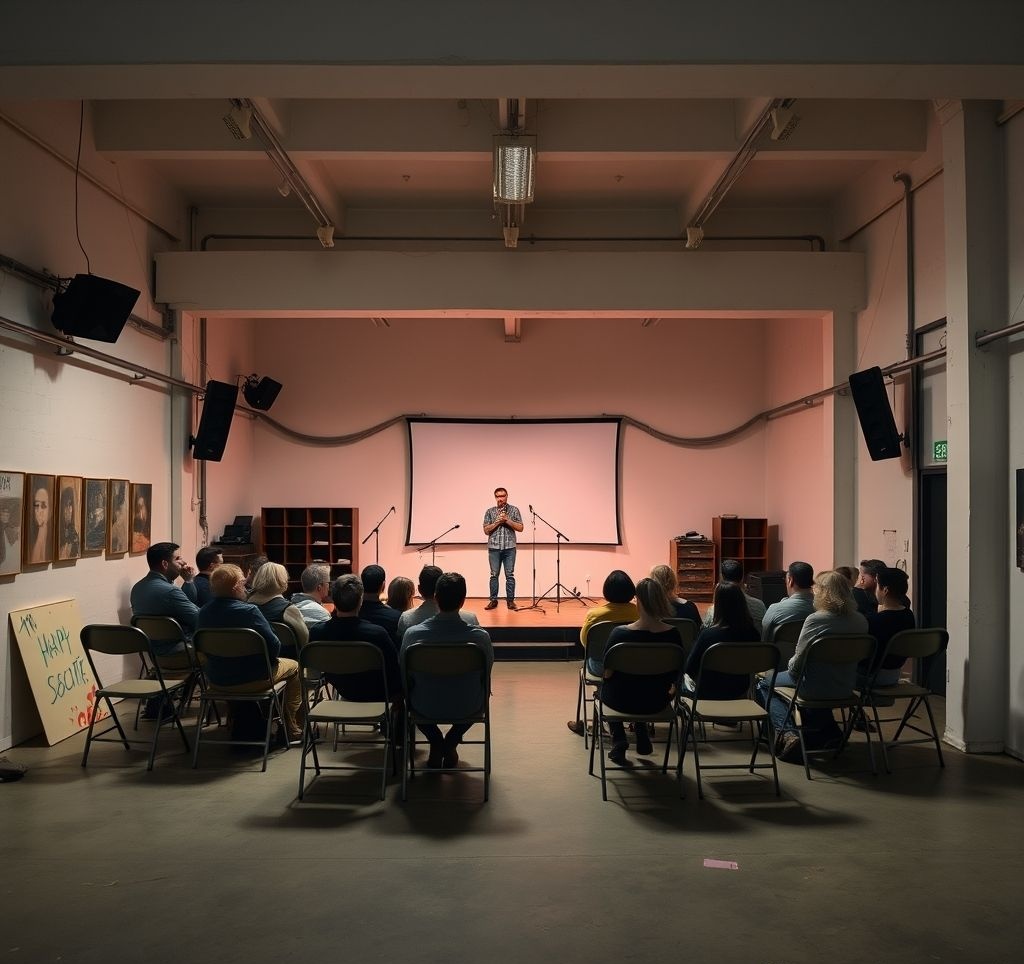
How to Start in Alternative Comedy: A Beginner's Guide
Your first mic, your first five minutes, your first bomb and what to do the morning after. A practical route into the weirder end of stand-up.
To start in alternative comedy, you do the same thing every stand-up does: write about five minutes, find an open mic, get on stage, record it, and come back next week. What makes it alt is where you go and what you allow yourself to try once you're up there. This guide walks through the whole first year, from finding a room to building a scene of your own.
If you're not sure what "alternative comedy" covers, read what alt comedy actually is first. In short: it's comedy that cares more about voice, form and surprise than about the conventional club set. Character pieces, slideshow lectures, anti-jokes, sincere storytelling, songs that fall apart on purpose. It is not a licence to be unprepared. The weirdest acts on any bill are usually the ones who have rehearsed hardest.
Before your first mic
You need less than you think. You don't need a class, an agent, headshots, a stage name or an Instagram strategy. You need:
- Five minutes of material, written down and said out loud many times.
- A phone to record your set.
- A notebook or notes app for ideas, which you'll carry permanently from now on.
- A list of mics in your area (see below).
- A willingness to be bad in public for a while. Everyone is. The comedians you admire bombed for years before you ever heard of them.
Watch a lot of live comedy before you go up, and not only on Netflix. Sit in the audience at the open mic you plan to do. You'll learn how the sign-up works, how long sets run, how the host introduces people, and what the room laughs at. You'll also discover that most first-timers are not very good, which is a great comfort.
Finding open mics and alt rooms
Open mics change constantly. Bars close, hosts burn out, Tuesdays become Wednesdays. That's why printed lists go stale and why the best information comes from comedians who are performing right now. Start with our open mic directory, then confirm every listing before you travel.
- Search locally. Try "[your city] open mic comedy" on Instagram, Facebook groups and Reddit (r/Standup and city subreddits). Many mics post weekly sign-up links.
- Check comedy venues directly. Clubs often run new-act nights; independent theatres and improv schools run mixed bills.
- Go to one and ask. At the end of any mic, ask two or three comics where else they go. You'll leave with a better list than any website.
- Learn the sign-up rules. Some mics are first come, first served on a paper list; some draw names from a bucket; some take online sign-ups days ahead; some ask you to buy a drink. Read the listing and follow it.
- Look for the experimental nights. Many cities have a mic or showcase that is openly friendly to characters, music, props and slideshows. These are the rooms where alt comedians tend to cluster.
Writing your first five minutes
Your first set is not your act. It's a test of a few ideas under real conditions. Keep it simple enough that you can remember it while terrified.
Step by step
- Brainstorm specifics, not topics. "Dating" is a topic. "I only find out people are flirting with me when I'm replaying the conversation in the shower three days later" is a premise. List twenty things that genuinely confuse, annoy or obsess you, and make each one specific.
- Pick three to five premises that feel most like you, the ones you'd talk about at a party anyway.
- For each premise, find the surprise. What's the unexpected angle, the twist in logic, the detail nobody else would notice? Our comedy writing techniques guide covers misdirection, reversal, escalation and tags in detail.
- Write it as you talk. Stand-up is spoken. Read every line aloud. Cut any sentence you'd never actually say.
- Cut the throat-clearing. Most first drafts take ninety seconds to reach the first laugh. Get there in fifteen.
- Choose an opener and a closer. Open with something short and confident. Close with the bit you trust most.
- Time it out loud. Five minutes on paper is often seven on stage, once you add pauses and laughs, or three when nerves make you rush. Rehearse until it fits comfortably in four.
For alt comedy specifically, it's tempting to start with the conceptual piece: the PowerPoint about your houseplants, the character who only speaks in customer-service phrases. Try it. But also have a couple of straightforward jokes you understand, so you can tell whether the room is cold or the concept isn't working. Our guide to alt comedy writing goes deeper on finding a voice that isn't just weirdness for its own sake.
Your first set: what to expect
You'll arrive early, put your name on the list and wait, probably for a long time. The host will call you up. The light (a phone torch, a lamp, a hand wave from the back) will tell you when you have a minute left. Then it's over, faster than seems possible.
Checklist for the night
- Write your set list on your hand, a card or a bottle label. Keywords only.
- Start the phone recording before you walk up and put the phone somewhere safe.
- Take the mic out of the stand or move the stand behind you. Don't hide behind it.
- Don't open with "I've never done this before". Just start.
- When the light goes on, finish your current bit and get off. Going over time is the fastest way to get banned from a mic.
- Stay and watch everyone else. Leaving straight after your set is the second-fastest way.
Record every set and review it
Recording is the single habit that separates people who improve from people who just keep going up. Your memory of a set is unreliable: you'll remember a bit as dying when it got a small laugh, or forget the throwaway line that got the biggest reaction of the night.
- Record audio of every set. A phone voice memo is enough. Video is useful occasionally to check body language, but audio is what you'll actually review.
- Listen the next day, not on the bus home when you're still flooded with adrenaline or shame.
- Mark three things: where the biggest laugh landed, where attention dropped (you can hear it: coughing, chatting, glasses), and any line you improvised that worked.
- Rewrite one thing before the next mic. Not everything. One tag, one cut, one clearer setup.
- Keep a log. A simple spreadsheet or document with the date, the room, the set list and a one-line verdict will show you patterns over months.
Don't post open-mic recordings publicly. You're working on material, not releasing it, and many rooms ask performers not to film. The longer process of taking a bit from first attempt to polished is covered in how to workshop material.
Alt rooms vs comedy clubs
Both are worth your time, and the best comedians can play both. But they reward different things, and knowing the difference saves you from drawing the wrong conclusions from a bad night.
| Comedy club | Alt room | |
|---|---|---|
| Where | Dedicated venue with a two-drink-minimum or ticket model | Back rooms of bars, bookshops, galleries, small theatres, sometimes living rooms |
| Who runs it | Club owners and bookers | Usually comedians producing their own shows |
| Audience | General public out for a night; may not know the acts | Often comedy fans and regulars who come for the line-up or the host |
| What works | High laugh rate, clear jokes, confident persona | Distinct voice, risk, ideas; a slow build can be welcome |
| Formats | Mostly straight stand-up | Characters, songs, slideshows, sketches, themed shows |
| Getting on | New-act nights, then bookings from club bookers | Mics, then asking producers, then producing your own |
The history of alt comedy is largely a history of rooms: the Comedy Store and Comic Strip in London, Un-Cabaret and Largo in Los Angeles, Luna Lounge in New York. Today the equivalent is the spread of small independent shows covered in the rise of micro-venues.
Building a scene
Alt comedy has always been a do-it-yourself movement. The rooms that mattered were started by comedians who didn't fit the existing ones. You don't need permission to do the same.
Be a good member of the room first
- Stay for the whole mic. Laugh at other people's sets. Pay attention.
- Tell people specifically what you liked. "That bit about the lift was great" lands better than "nice set".
- Show up regularly at two or three mics. Regulars get to know each other, and booked spots come from those relationships.
- Never take someone else's premise or joke, even half-consciously. If you hear a bit that resembles one of yours, talk to the comic.
Then start your own show
- Find a room. A bar with a quiet back room on a slow night, a bookshop after closing, a café. Venues often say yes to anything that brings people in on a Tuesday.
- Give it a hook. A theme, a format, a host persona, a rule ("everyone must do something they've never done before"). Hooks get audiences and acts interested.
- Book a mix. A couple of stronger acts to anchor the night, plus people you want to see develop. Pay performers if there's any money at all, even a split of the door.
- Promote it like it matters. A consistent day, a clear poster, a mailing list or group chat for regulars. Listing it with the venue and on local event pages helps.
- Keep it going. Most shows take months to find an audience. Consistency is the whole trick.
Producing a show is also the quickest way to meet comics from other scenes, because you'll be booking them and they'll book you back. It's how collectives form, and collectives are how most of the great alt comedy groups started.
Your first year, roughly
Everyone moves at a different pace, and stage time varies hugely between cities. This is a typical shape, not a deadline:
- First few months: mics as often as you can manage. Try lots of different ideas. Get used to the stage. Record everything.
- Months three to six: start noticing which bits survive. Build towards a reliable five minutes. Try a few different rooms, including a club new-act night.
- Six months to a year: a tight five you're proud of, and the first booked spots on friends' shows. Maybe your own night. Start writing longer pieces or a character.
- Beyond: longer sets, festivals, a first solo hour (see how to write a Fringe hour), perhaps a podcast or recorded set.
Books and listening for beginners
None of these replace stage time, but they'll sharpen your thinking:
- Born Standing Up by Steve Martin: the best memoir about learning stand-up the slow, strange way, and about the anti-comedy instinct that shaped his act.
- Truth in Comedy by Charna Halpern, Del Close and Kim "Howard" Johnson: the classic improv text, useful for any performer who wants to build comedy from honest reactions.
- The Upright Citizens Brigade Comedy Improvisation Manual: the clearest explanation of "finding the game", which applies to sketch and stand-up too.
- Sick in the Head by Judd Apatow: decades of interviews with comedians talking about process.
- Comedians' podcasts about craft and careers. Our best comedy podcasts list is a good starting point, and Marc Maron's WTF back catalogue is full of comedians describing how they started.
Most of all, watch the people in your local scene who are six months to two years ahead of you. They're solving the exact problems you're about to have.
Frequently asked questions
How do I start doing alternative comedy?
Write about five minutes of material, find an open mic that welcomes experimental work, record your set, and go back every week. Alt comedy is learned on stage like any other stand-up; the difference is the rooms you seek out and the freedom you give yourself in form.
Do I need to take a comedy class first?
No. Classes can help with structure and give you a first audience, but most comedians learn by doing open mics. If you take one, treat it as a head start, not a qualification.
How long should my first set be?
Most open mics give you three to seven minutes. Prepare five, rehearse it to fit four, and always respect the light that tells you your time is up.
What's the difference between an alt room and a comedy club?
Clubs sell tickets and drinks to a general audience and reward reliable, punchy stand-up. Alt rooms are usually smaller, run by comedians in bars, bookshops or theatres, and their audiences expect and enjoy experiments: characters, slideshows, songs, odd premises.
How often should a new comedian perform?
As often as you can without burning out; several times a week if your city allows it. Stage time is the main way material and confidence improve, and long gaps between sets make every set feel like the first one.