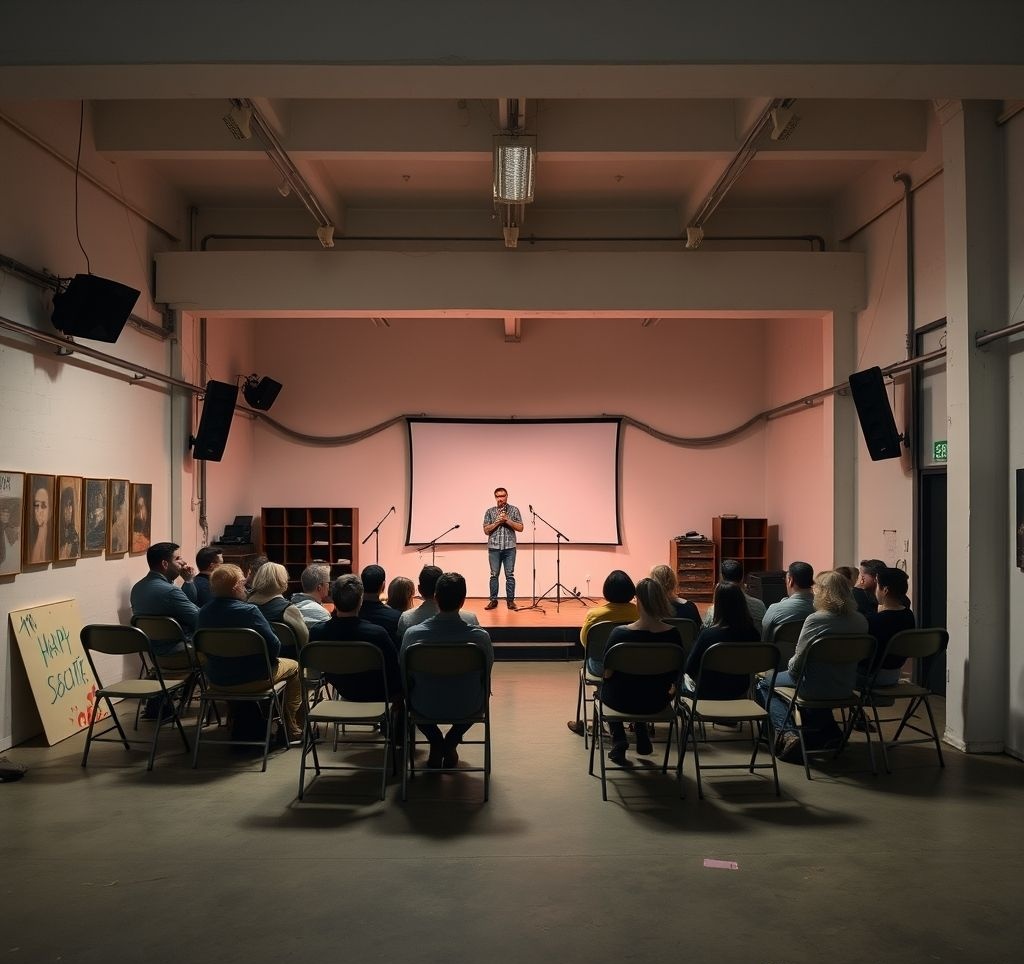
The Upright Citizens Brigade Theatre: A History of UCB, 1990 to Now
A sketch group from Chicago opened a basement theatre in Chelsea and accidentally built the main talent pipeline of 21st-century American comedy. Then it nearly vanished.
The Upright Citizens Brigade began as a sketch and improv group in Chicago in 1990, moved to New York in 1996 and opened the UCB Theatre in a Chelsea basement in 1999. Over the next two decades its four founders, Matt Besser, Amy Poehler, Ian Roberts and Matt Walsh, built theatres and schools on both coasts that trained a remarkable share of American TV comedy. In 2020 the pandemic closed its New York theatre and its Los Angeles flagship. New owners revived the brand from 2022.
This is the full history: the group, the Comedy Central show, every theatre, what the school taught, who came through, why it collapsed and what it looks like now. For the Chicago tradition UCB grew out of, see our guide to the Chicago comedy scene.
The group: Chicago, 1990
The Upright Citizens Brigade formed in Chicago in 1990 among students of Del Close at ImprovOlympic (later iO). Its early lineup included Besser, Poehler, Roberts, Walsh, Adam McKay and Horatio Sanz. They played small Chicago rooms and developed a style that mixed sketch and long-form improvisation, with a running conceit that the group was a shadowy organisation dedicated to sowing chaos.
Two members left early for Saturday Night Live. Adam McKay joined SNL's writing staff in 1995 and became head writer soon after, a post he held through the late 1990s. (That is the answer to the trivia question people search for: the original UCB member who became SNL head writer is McKay, who later directed Anchorman and The Big Short and shares screenplay credit on Marvel's Ant-Man.) Horatio Sanz joined the SNL cast in 1998. Amy Poehler followed him in 2001.
New York and the Comedy Central show
In 1996 Besser, Poehler, Roberts and Walsh moved to New York. They began performing ASSSSCAT, an improv show built from a guest's true stories, at KGB Bar in the East Village and then at Solo Arts. The New York alternative scene at that time was mostly stand-up in bars (see our history of Luna Lounge and Eating It), and a long-form improv troupe was a novelty.
Comedy Central gave the group a sketch series, Upright Citizens Brigade, which ran for three seasons from 1998 to 2000. Like Monty Python's Flying Circus and Mr. Show, it linked its sketches into a continuous episode, framed by the conspiracy premise. It never became a hit, but it gave the four a national profile and a cult audience at exactly the moment they needed one.
The theatres, stage by stage
- 1999
West 22nd Street, Chelsea
The first UCB Theatre opened on February 4, 1999, at 161 West 22nd Street. It closed in November 2002 after fire code violations, and the company spent several months in temporary homes.
- 2003
West 26th Street
In April 2003 UCB reopened in a basement theatre at 307 West 26th Street, in the former Maverick Theater. This is the room most people mean when they talk about "UCB Chelsea": low ceilings, cheap or free tickets and shows running late into the night.
- 2005
Franklin Avenue, Los Angeles
UCB opened a Hollywood theatre at 5919 Franklin Avenue, following the migration of its performers to TV jobs in LA and making the company bicoastal.
- 2011
UCBEast
A second New York venue opened at 153 East 3rd Street in the East Village to absorb demand. It closed permanently in February 2019.
- 2014
Sunset Boulevard
A larger Los Angeles theatre and training complex opened at 5419 Sunset Boulevard and became the West Coast flagship.
- 2017–18
Hell's Kitchen
After the 26th Street lease ended in 2017, the New York theatre moved to 555 West 42nd Street in Hell's Kitchen.
- 2020
Closures
UCB laid off its staff in March 2020 as the shutdown began. In April it announced the permanent closure of the Hell's Kitchen theatre and its Eighth Avenue training centre. The Sunset Boulevard building was sold in December 2020.
- 2022
New owners
In March 2022 UCB was acquired by Mike McAvoy, formerly chief executive of The Onion, and producer Jimmy Miller. The Franklin Avenue theatre reopened that September.
- 2024
Back in New York
A New York theatre opened at 242 East 14th Street in September 2024. In 2025 the company began expanding beyond its two home cities, adding training and shows in Austin and Pittsburgh.
What UCB taught: the Harold and "the game"
UCB's founders brought Del Close's long-form structure, the Harold, from Chicago: a roughly half-hour improvised piece in which an opening sparks three interwoven scenes, a group game, a second round of scenes and so on, until the threads tie together. The Harold was the backbone of UCB's house teams for most of its history, and getting picked for a "Harold team" was the scene's main status marker.
UCB's own contribution was a sharper theory of what makes a scene funny. Its teaching centres on finding "the game of the scene": the first unusual thing that happens, which the performers then identify, heighten and explore with a consistent logic. It is a comedy-first approach, closer to sketch writing than to the more theatrical, relationship-led improv of some Chicago schools, and it explains why UCB graduates were so employable as sketch writers. The founders codified it in The Upright Citizens Brigade Comedy Improvisation Manual (2013).
The school ran a standard sequence of levels (101 to 401, plus advanced study, sketch writing and character classes). The curriculum was deliberately consistent between cities, which made UCB scalable in a way older apprenticeship-style improv theatres were not. Our page on improv and alt comedy covers the wider form.
The shows that mattered
- ASSSSCAT. The founders' flagship: a guest monologist tells true stories and an all-star cast improvises from them. It ran on Sunday nights in New York for years and travelled to LA. Tickets were cheap or free, and queues formed hours early.
- Harold Night. The weekly showcase of house teams, where future SNL cast members and writers learned in public.
- Comedy Death-Ray. Scott Aukerman and BJ Porter's weekly stand-up and variety show became a fixture at UCB's Los Angeles theatre and one of the city's essential alternative bills. It turned into the radio show and podcast Comedy Death-Ray Radio, later renamed Comedy Bang! Bang!, the foundation of the Earwolf network. See our guide to Earwolf and Comedy Bang! Bang!.
- Character and sketch shows. Hundreds of small, weird, short-run shows, from one-person character pieces to themed sketch revues, gave performers somewhere to develop a voice without a club's demands.
The alumni: why UCB became a pipeline
By the mid-2000s, UCB was the fastest route from "I want to do comedy" to a writers' room. Writers' rooms wanted people who could generate premises quickly and heighten them reliably, which is exactly what the "game" approach trained. Casting directors wanted performers who could commit to absurd characters without winking. And the theatre was cheap to attend, so agents and producers came.
A partial list of people who trained, taught or performed there:
- Co-founders and early members: Amy Poehler (SNL, Parks and Recreation), Matt Walsh (Veep), Matt Besser (the Improv4Humans podcast), Ian Roberts, Adam McKay, Horatio Sanz.
- SNL: Kate McKinnon, Bobby Moynihan, Sasheer Zamata and Bowen Yang among many cast members and writers.
- TV creators and stars: Ilana Glazer and Abbi Jacobson, whose Broad City web series grew out of the UCB community; Aziz Ansari, Rob Huebel and Paul Scheer (Human Giant); Donald Glover; Aubrey Plaza; Ellie Kemper; Jessica St. Clair and Lennon Parham; Ayo Edebiri.
- Podcasting: Scott Aukerman, Paul Scheer and many of the regulars of the Earwolf network.
Plenty of famous names took a class or two; the deeper influence is in the thousands of writers, producers and character actors who learned the same comedic grammar. Watch almost any American sketch show of the 2010s and you can see the "find the game, heighten it" shape.
The criticism
The same model that made UCB efficient also generated its biggest problems.
- Unpaid performers. For most of its history, performers on house teams and most shows were not paid, even as UCB sold tickets and classes. As comedy careers became more professionalised in the 2010s, this drew growing criticism.
- Cost and access. Several levels of classes at several hundred dollars each, followed by years of unpaid stage time, filtered out people who couldn't afford it. That fed long-running criticism that the theatre's teams and pipeline were overwhelmingly white.
- Expansion. Running four theatres and two schools on two coasts proved expensive. UCB closed its East Village theatre and cut staff in early 2019, a year before the pandemic.
After UCB: the diaspora and the revival
The closures scattered a huge community. Teachers launched independent online classes, performers moved to smaller theatres, bars and DIY rooms, and the New York and LA scenes became more decentralised than at any time since the 1990s. Independent venues such as Caveat in Manhattan and Dynasty Typewriter in Los Angeles became important homes for alternative shows, and much of the energy moved into one-off and pop-up shows (see our piece on the rise of micro-venues).
The revived UCB, under owners from outside the founding group, is smaller and more conventional as a business. As of 2026 it runs theatres and classes in Los Angeles and New York and has begun expanding to other cities. Whether it regains its old centrality is an open question; the scene it once concentrated has learned to live without a single centre.
Legacy
UCB's real achievement was to turn a Chicago art form into a repeatable system: a teachable theory of the comic scene, a school that could run in any city, and cheap shows that brought industry people to the talent. It lowered the barrier to entry for a generation, and it had real blind spots about who could afford to walk through the door. Its comic grammar outlived its buildings. You can hear it in 2000s alt comedy, in the podcast boom and in the sketch shows of the streaming era.
Frequently asked questions
Who founded the Upright Citizens Brigade?
The group formed in Chicago in 1990 out of ImprovOlympic. Its early lineup included Matt Besser, Amy Poehler, Ian Roberts, Matt Walsh, Adam McKay and Horatio Sanz. Besser, Poehler, Roberts and Walsh moved to New York in 1996 and opened the UCB Theatre in 1999.
Which original Upright Citizens Brigade member became head writer of Saturday Night Live?
Adam McKay. He joined SNL as a writer in 1995 and was soon promoted to head writer, a role he held into the late 1990s. He went on to direct Anchorman and The Big Short and was one of the credited screenwriters of Marvel's Ant-Man (2015).
Is the UCB Theatre still open?
Yes, in a smaller form. After closing its New York theatre and selling its Sunset Boulevard building in 2020, UCB was bought by new owners in 2022. The Franklin Avenue theatre in Los Angeles reopened that year and a New York theatre on East 14th Street opened in 2024.
Why did UCB close in 2020?
The COVID-19 shutdown removed all of its income from shows and classes. The founders said they could no longer afford the New York leases, and the theatre had already been contracting after years of criticism over unpaid performers and a lack of diversity.
Which famous comedians came out of UCB?
Alumni include Amy Poehler, Aziz Ansari, Donald Glover, Ilana Glazer and Abbi Jacobson, Kate McKinnon, Aubrey Plaza, Ellie Kemper, Bobby Moynihan, Bowen Yang and Ayo Edebiri, plus hundreds of TV writers.