Comedy Communities: How Alternative Comedy Scenes Are Born, Sustained and Lost
Every great comedy scene starts as a few dozen people in the same room every week. What makes some of those rooms turn into movements, and why most of them fade?
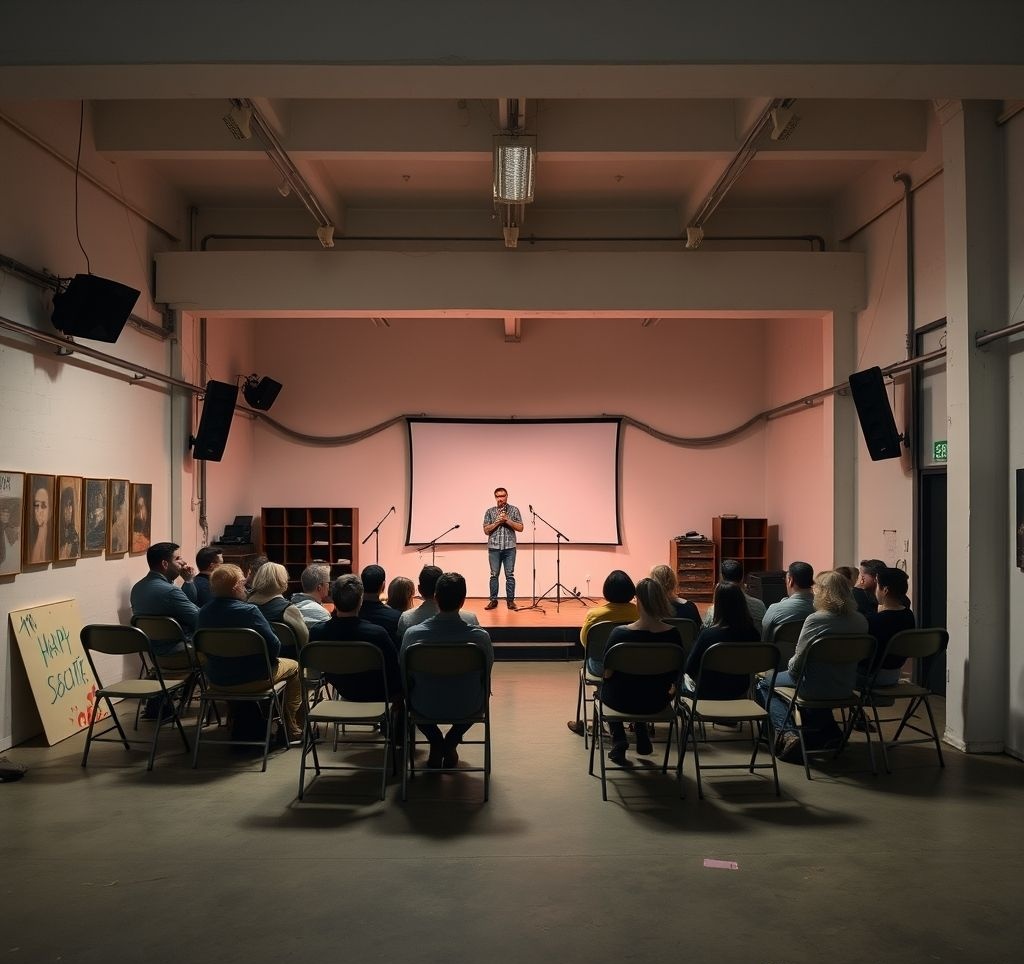
Comedy scenes form around a regular room, a regular night and a cohort of comedians who keep showing up to watch each other. Add an audience that wants experiment, a shared sense of what the scene is reacting against, and some way of getting the work out to the wider world, and a few dozen people in a bar can become a movement. They fade when the room closes, rent rises, or the best members get famous and leave. Collectives, independent shows and online communities are all ways of keeping that machinery running.
This is an analytical look at how alternative comedy communities work, with examples from London, New York, Los Angeles, Chicago and the internet. If you're looking for the practical side (how to find shows, open mics and people), read our guide to getting involved in the alt comedy community.
Why comedy needs a community at all
Stand-up looks like a solo art, but it is learned socially. A comic needs stage time, which someone has to produce. They need honest feedback, which mostly comes from other comics at the back of the room. They need to see what's possible, which comes from watching peers try things. And they need work, which in comedy flows through personal networks: who booked whom, who recommended whom for a writers' room.
Alternative comedy needs community even more, because it rejects the infrastructure of the mainstream. A club comic can plug into an existing circuit. A comedian doing strange, slow, conceptual or confrontational material has to find or build the few rooms where that work makes sense, and the audience who will sit through it.
The anatomy of a scene
Looking across the big alternative movements, the same ingredients keep appearing.
- An anchor room. One regular show that everyone in the scene goes to. The Comedy Store and the Comic Strip in London from 1979–1980; Un-Cabaret on Sunday nights in West Hollywood; Eating It on Mondays at Luna Lounge in New York. The anchor is where the scene sees itself.
- A cohort. A group of performers at a similar stage, close enough in age and ambition to compete and collaborate. Scenes are often remembered by their cohorts: the first Comic Strip company, the late-1990s Chicago iO generation, the Brooklyn comics of the late 2000s.
- A risk-tolerant audience. People who come for the experiment rather than guaranteed laughs. Without them, nothing new survives its first bad night.
- Something to define itself against. British alternative comedy against working men's club racism and sexism; American alt comedy against the brick-wall club formula of the stand-up boom. A shared opponent sharpens a shared aesthetic.
- Documentation. Something that carries the scene beyond the room: a TV show, an album, a podcast, a festival hour, a viral video. The Comic Strip Presents and The Young Ones turned a Soho club into a national movement within three years.
- An economic floor. Cheap rent, cheap tickets, day jobs that leave evenings free. Scenes cluster where performers can afford to spend years being unprofitable.
Collectives: pooling talent and audiences
A collective is a group of comedians who produce work under a shared name. It solves several problems at once: no individual has to fill a room alone, skills are pooled (one writes, one edits, one books venues), and the group can develop a house style no individual could.
- The Comic Strip (London, 1980) was both a venue and a company. Its core performers went on to make films together for decades. See our profile of the Comic Strip.
- The Kids in the Hall developed in Toronto clubs in the mid-1980s, with a shared absurdist sensibility that became a TV series.
- The Upright Citizens Brigade began as a Chicago troupe in 1990, then built a theatre and school that institutionalised its collective method. Our UCB history follows that arc.
- The Lonely Island (Andy Samberg, Akiva Schaffer and Jorma Taccone) made comedy videos for the web before SNL hired all three in 2005.
- Derrick Comedy, formed by Donald Glover, DC Pierson and Dominic Dierkes among others at NYU, built a big YouTube audience in the mid-2000s and made the film Mystery Team (2009).
Collectives tend to have a natural lifespan. They are strongest when nobody in them is famous yet, and they usually loosen when one or two members break through. Our page on collaborative comedy looks at how groups write together.
Tours and networks: communities on the move
Sometimes a scene's community is a shared circuit rather than a city. In 2004 Patton Oswalt, Brian Posehn, Maria Bamford and Zach Galifianakis toured as The Comedians of Comedy, playing indie rock clubs rather than comedy clubs. A documentary and a Comedy Central series followed. The tour's real achievement was proving that an alternative comedy audience existed nationally and overlapped with indie music fans, and that comics could reach it without the club circuit.
Festivals do something similar. The Edinburgh Fringe works as an annual reunion of the British and international alternative scene, where performers live in the same city for a month, see each other's shows and form the friendships and collaborations that shape the next year. Just for Laughs in Montreal, the Melbourne International Comedy Festival and many smaller festivals play the same role. See our guide to comedy festivals.
Institutions: when a community becomes a building
Some scenes harden into institutions: Second City and iO in Chicago, UCB in New York and Los Angeles. Institutions give a community stability, training and a reliable pipeline to industry jobs, as our Chicago scene history shows. But they bring their own risks. They create gatekeepers, they can rely on unpaid performers, and they concentrate the whole community's fate in one lease. When UCB closed its New York theatre and iO shut its doors during 2020, thousands of performers lost their community in a few weeks, alongside a public reckoning over who those institutions had served and excluded.
The post-2020 scene in many cities has swung back toward independent shows: small, producer-run nights in bars, bookshops and DIY spaces. We look at that trend in the rise of micro-venues.
Online communities
Since the mid-2000s, a growing share of comedy community has lived online. The forms have changed every few years:
- YouTube sketch groups in the 2000s, which found audiences without TV and often formed through college comedy groups.
- Podcasts, which turned comedians' backstage conversations into public entertainment. Shows like WTF and Comedy Bang! Bang! created communities of listeners who knew a whole scene's in-jokes, and networks like Earwolf functioned as virtual green rooms. See our guide to comedy podcasts.
- Twitter, which in the 2010s worked as a giant writers' room, launching joke writers into TV jobs and building a recognisable "comedy Twitter" style.
- Vine, then TikTok and Instagram, which rewarded short character pieces and crowd-work clips, creating stars who had never done a club set and audiences who followed comedians before ever seeing one live.
- Group chats and Discord servers, where today's comedians share mic lists, feedback and gossip that once happened at the bar after the show.
Online communities remove the geographic barrier: a comic in a small town can find a peer group. But they are weaker at the thing scenes do best, which is watching someone fail and try again in the same room next week.
Inclusion: who gets in
Comedy communities have often been closed in ways their members didn't notice. Scenes form around networks of friends, and friendship networks reproduce themselves. Expensive classes, unpaid stage time and late-night bars all filter out people without money, free time or a sense that they're welcome.
Many of the most important comedy communities were built in response. Black comedy rooms and tours, Asian American sketch groups, queer line-ups and shows run by and for women were created because the existing scenes didn't book those performers. They often became the most creatively vibrant parts of the wider scene. Our page on inclusivity in comedy covers that history.
How scenes end
- The room closes. Luna Lounge lost its lease in 2005 and its Monday comedy night ended with it. Venue loss is the most common cause of death.
- Success scatters the cohort. The best people get TV jobs and move to Los Angeles, and the scene loses its centre.
- The rent rises. The cheap neighbourhoods that incubate scenes become expensive, partly because creative scenes made them fashionable.
- Trust breaks down. Scandals, exploitation and abuse within a scene can fracture it, and in recent years many communities have had to work out how to deal with harassment by members.
- The opponent disappears. When the alternative becomes the mainstream, the shared sense of purpose fades, and a new scene forms in reaction.
Frequently asked questions
What is a comedy community?
A comedy community is the network of performers, producers and regular audiences around a set of shows, venues or online spaces. It shares stage time, feedback, gossip, jobs and an aesthetic, and that shared context is what lets a group of comedians develop a distinctive style together.
How do comedy scenes form?
Usually around a regular room on a regular night, where a cohort of comedians at a similar stage watches each other perform. Add an audience that wants experiment, a shared sense of what the scene is against, and some way of documenting the work, and a scene can grow into a movement.
What is a comedy collective?
A group of comedians who produce shows, sketches or videos together under a shared name, pooling their audiences and skills. Examples include the Comic Strip in 1980s London, The Kids in the Hall, The Lonely Island and Derrick Comedy.
How do I join a comedy community?
Go to the same shows and open mics regularly, perform when you can, help out producing, and support other people's work. Our practical guide to getting involved in the community covers the steps in detail.