AI and Comedy: Can a Machine Be Funny, and Who Gets Hurt Trying?
From 1990s pun generators to an AI Seinfeld banned from Twitch and a fake George Carlin special, here is what actually happened when comedy met artificial intelligence, and why the writers' guild fought so hard over it.
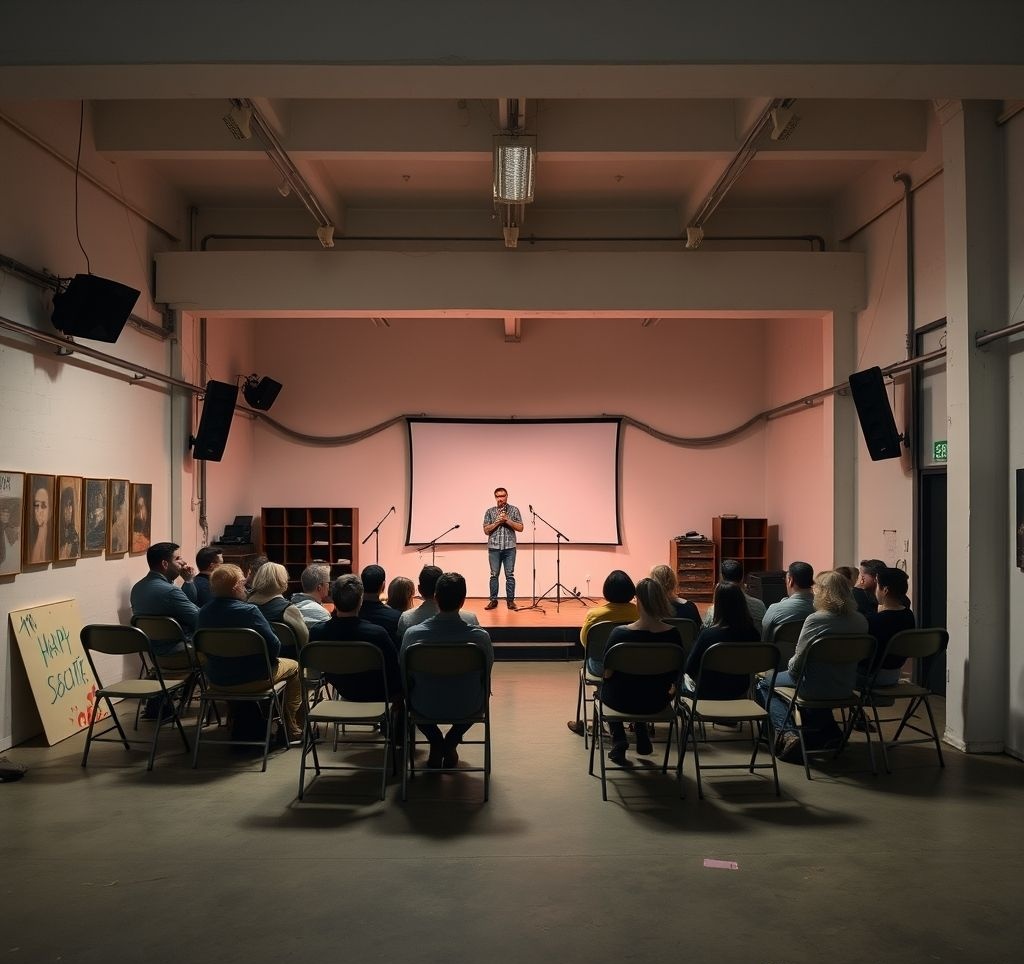
AI comedy means two different things, and it helps to separate them. One is comedy made by artificial intelligence: jokes, scripts, voices and videos generated by software. The other is comedy made by people about artificial intelligence. After three decades of experiments, the first kind is still mostly a curiosity that is funny by accident. The second is thriving. This page covers the machine side: what has actually been tried, what went wrong, what the writers' guild won, and what comedians found when they sat down with a chatbot.
If you are after a broader history, our companion pieces cover how technology changed the way comedy reaches audiences and how comedians satirise technology, from Bo Burnham's Inside to Silicon Valley.
Why jokes are hard for machines
Most theories of humour come back to incongruity: a joke sets up an expectation and then breaks it in a way that suddenly makes a different kind of sense. The psychologists Peter McGraw and Caleb Warren call one version of this the "benign violation" theory. Something seems wrong, threatening or absurd, but also safe, and the collision makes us laugh.
Large language models are built to do roughly the opposite. They predict the most plausible next word given everything before it. That makes them superb at sounding like a joke (the rhythm of a setup, the shape of a punchline, the "so I said to the guy" connective tissue) and weak at the part that matters: the surprising, specific, slightly dangerous turn a human writer reaches for precisely because nobody else would.
Three other problems compound it:
- No point of view. A joke lands partly because of who is telling it. Maria Bamford's material about psychiatric wards is funny because it is hers. A model has no biography, no body and nothing at stake, so its confessional jokes are hollow by design.
- Safety tuning. Commercial chatbots are trained to avoid offence, which pushes them away from the edges where a lot of comedy lives. Ask for a dark joke and you often get a gentle pun with a disclaimer.
- No room. Stand-up is refined in front of audiences, one tiny adjustment at a time. A model can generate a thousand drafts, but it cannot feel a room go cold after the third word.
A short history of computers telling jokes
- 1990s
JAPE and the pun machines
Academic "computational humour" began with tightly rule-based systems. The best known, JAPE, developed at the University of Edinburgh by Kim Binsted and Graeme Ritchie, generated punning riddles from a dictionary of word relationships. A later project, STANDUP, adapted the idea to help children with communication difficulties play with language. The jokes were groaners, but they were real jokes, built on rules a person could inspect.
- 2016
Sunspring
Director Oscar Sharp and researcher Ross Goodwin trained a neural network (it named itself Benjamin) on science-fiction screenplays and shot exactly what it produced, with Thomas Middleditch in the cast. The result is a nine-minute short of confident, nonsensical dialogue. It is funny the way a stranger's dream is funny, and the actors' commitment does most of the work.
- 2017–2019
The "I forced a bot" era
Comedy writer Keaton Patti's viral scripts ("I forced a bot to watch over 1,000 hours of…") were not written by a bot at all. They were human parodies of what machine writing might look like, and their popularity showed that audiences already found the idea of a confused machine inherently funny. Around the same time, research scientist Janelle Shane's blog AI Weirdness collected the genuinely strange output of small neural networks: paint colours, recipes and pickup lines. Her 2019 book takes its title, You Look Like a Thing and I Love You, from one of them.
- 2016 onward
Improvising with a machine
Researchers Piotr Mirowski and Kory Mathewson, both improvisers, built shows in which human performers improvise scenes with an AI-driven character, later under the name Improbotics. The comedy came from the humans' attempts to justify whatever the machine said, which is a very old improv skill pointed at a new kind of scene partner.
- Dec 2022 – Feb 2023
Nothing, Forever
An endless, AI-generated Seinfeld parody streamed on Twitch around the clock, with blocky graphics and dialogue from OpenAI's GPT-3. It drew a large audience as a novelty, then was suspended for 14 days in February 2023 after its Seinfeld stand-in, "Larry Feinberg," delivered transphobic lines in a stand-up segment. The creators blamed a switch to a less moderated model after an outage and said the material did not reflect their values.
- Jan 2024
The fake George Carlin special
The podcast Dudesy, hosted by Will Sasso and Chad Kultgen, released an hour-long video presented as an AI imitation of the late George Carlin. Carlin's estate sued for copyright infringement and misuse of his likeness. A spokesperson for Sasso then said the special had been written by Kultgen, not by AI. The case settled in April 2024, with the video taken down and a commitment not to use Carlin's voice or likeness without permission.
- 2025
Video models learn to do stand-up
When Google released its Veo 3 video model in May 2025, one of the clips that spread fastest was a photoreal "comedian" in a small club, lip-synced and with a laughing crowd. OpenAI's Sora 2 app followed at the end of September 2025. Within months, AI-generated sketches, fake street interviews and "stand-up" clips were a routine part of short-video feeds.
What comedians found when they tested it
The most useful evidence comes from a study led by Piotr Mirowski at Google DeepMind and presented at the ACM FAccT conference in 2024. The team ran workshops with 20 professional comedians, some at the 2023 Edinburgh Festival Fringe and some online, who tried writing material with popular chatbots including ChatGPT and Bard.
The findings were blunt. The comedians said the tools could help with structure, a rough first draft or getting past a blank page. But the jokes themselves were generic, predictable and leaned on stereotypes. The models struggled with irony, sarcasm and dark humour, and safety filters blocked much of the edgier material the participants actually wanted to explore, including jokes about their own identities. One participant summed up the output as like old cruise-ship material, "but a bit less racist."
That matches what many working comics say in interviews and on podcasts: an assistant can suggest twenty obvious angles on a premise, which is occasionally useful as a list of what not to write. Nobody in that study came away thinking the machine could replace the part of the job where you find out what you, specifically, think is funny.
The writers' strike and the AI rules
The single most important event in AI and comedy did not involve a joke. In May 2023, the Writers Guild of America went on strike against the major studios, and AI was one of the central issues. Late-night shows went dark immediately; sketch and sitcom rooms followed. The strike lasted 148 days and ended in late September 2023.
The resulting contract, the 2023 Minimum Basic Agreement, set out rules that were widely described as the first serious labour protections against generative AI in any industry:
- AI cannot write or rewrite literary material, and AI-generated text is not considered literary material under the contract.
- AI output cannot be treated as "source material," so a studio cannot hand a writer a chatbot draft and pay them a lower rewrite fee.
- A writer may choose to use AI tools if the company agrees, but a company cannot require a writer to use them.
- Companies must disclose when material given to a writer was generated by AI or contains AI-generated material.
- The guild reserved the right to argue that using writers' work to train AI is prohibited under the contract or other law.
The actors' union SAG-AFTRA struck from July to November 2023 and won consent and pay requirements around "digital replicas" of performers, which matters for comedians whose voice and face are the product. Those 2023 rules became the starting point for the next round: the WGA's members ratified a new four-year contract in spring 2026. For the exact current language, the guild's own published summaries are the authority.
Comedians in the fight over training data
Comedy's most visible legal stand came from Sarah Silverman. In July 2023 she joined authors suing OpenAI and Meta, alleging their models had been trained on pirated copies of books including her memoir The Bedwetter. The cases have moved slowly and much of the original complaint has been narrowed or dismissed; in 2025 a federal judge ruled for Meta on the arguments presented in that suit, while stressing that the decision did not mean AI training on copyrighted work is automatically lawful. The broader question is still being fought across many cases.
The Carlin case raised a different issue: not training data but likeness. Kelly Carlin, the comedian's daughter, said she hoped the case would stand as a warning about what AI could do to artists, and the estate's lawyer described the settlement as a template for future disputes. For stand-ups, whose entire product is a voice and a persona, that matters more than any question about joke-writing.
In late 2025 the debate reached performers again when a production company run by Dutch comedian and actor Eline Van der Velden promoted "Tilly Norwood," an AI-generated actress. SAG-AFTRA condemned the project, and the backlash from actors was immediate. Whatever its creators intended, it read to most performers as a demonstration of the thing they had just gone on strike to prevent.
Where AI is genuinely funny
None of this means machines are useless to comedy. They are just funny in a particular, limited way:
- As a straight man. A literal-minded machine taking a ridiculous prompt seriously is a classic comic setup. Improvisers and online creators get real laughs by treating a chatbot as the most earnest person in the scene.
- As a source of glorious nonsense. Shane's lists and Sunspring work because small, broken models produce outputs no human would think of. Ironically, as models got better, they got less funny in this way.
- As a subject. The best AI comedy is human comedy about our anxieties: the uncanny valley, the corporate pitch, the fear of being replaced. Our page on comedy about technology covers the satirists who do this well.
- As a production tool. Independent creators use AI for unglamorous tasks like captioning, cleaning audio or roughing out storyboards. This is where the tools are quietly most used and least discussed, and it is also where the line between "tool" and "replacement" for paid crew is drawn job by job.
The ethical questions that won't go away
Comedy has always borrowed, parodied and imitated. Impressionists have done everyone from Nixon to Trump. So what makes AI different? Three things come up again and again in the comedy ethics debate:
- Consent and the dead. An impressionist doing Carlin is obviously a living person doing a bit. A synthetic Carlin "doing new material" puts words in a dead man's mouth that he cannot reject.
- Scale. One person stealing a joke is a scandal. A system trained on every transcribed set on the internet, then used to produce endless near-copies, is a structural problem, and comedy is a form where jokes already have weak legal protection.
- Disclosure. Audiences increasingly cannot tell whether a clip is real. A fake street interview or a fake "crowd work" moment trades on the trust that live comedy depends on.
What to expect next
As of late 2026, the realistic picture is less dramatic than the hype in either direction. AI is not writing the comedy specials people talk about, and the guild contracts make it harder for studios to try. It is, however, flooding short-video platforms with synthetic sketches and fake clips, which makes human-made, live, specific comedy more valuable, not less. If anything, the current fashion for unpolished formats (crowd work, street interviews, lo-fi character videos) is partly a bet that audiences will pay for proof a real person was in the room.
For the bigger picture of where comedy is heading, see our guide to comedy trends in 2026, and for how clips and platforms shape what comedians make, read comedy on YouTube, TikTok and beyond.
Frequently asked questions
What is AI comedy?
AI comedy is any comedy in which artificial intelligence plays a role: jokes or scripts generated by language models, AI-generated video and voices, live shows where performers improvise with a machine, and the much larger body of human-made comedy that is about AI. So far the most interesting work sits in the last category.
Can AI write good jokes?
Not reliably. In a Google DeepMind study published in 2024, 20 professional comedians who tested chatbots found them useful for structure and first drafts but said the jokes were bland, stereotyped and safe. Models predict likely text, and good jokes usually depend on the unlikely.
What did the 2023 writers' strike decide about AI?
The 2023 WGA contract says AI cannot write or rewrite literary material, AI output cannot count as source material, studios cannot require writers to use AI, and studios must disclose when material handed to a writer was AI-generated. The guild also reserved the right to argue that training AI on writers' work is prohibited.
Was the AI George Carlin special really written by AI?
No, according to the people who made it. After Carlin's estate sued in January 2024, a spokesperson for the Dudesy podcast said the hour had been written by co-host Chad Kultgen, not by an AI. The case settled in April 2024 and the special was taken down.
Has AI affected comedy movies and TV?
Mostly through labour rules rather than finished work. The 2023 writers' and actors' strikes produced contract limits on AI writing and digital replicas, and no major comedy film or series has been credited as AI-written. The visible impact so far is in short online video, where AI-generated clips have become common since 2025.